

HOUSTON, Texas (June 8, 2026)—A startup company built on a new therapeutic created at the University of Nebraska Medical Center’s College of Pharmacy recently announced the close of a $6.5 million funding round.
The successful seed round of investment will allow Goldenrod Therapeutics, Inc., to complete the studies required for pursuing clinical trials in 2027, according to a company press release issued last week.
Goldenrod Therapeutics is a drug development startup focused on treating brain inflammation common in several debilitating and degenerative neurological conditions. Their core technology is called “11h,” a molecule that UNMC chemist Corey Hopkins, PhD, developed to inhibit a natural protein called PDE4 or phosphodiesterase 4.
“It is exciting and gratifying to see your work possibly improve someone’s life,” Dr. Hopkins said. “For 11h, its progress means a lot because of all the effort put in by students and postdocs over the years. So, it’s fantastic that their hard work is getting closer to actually helping patients.”
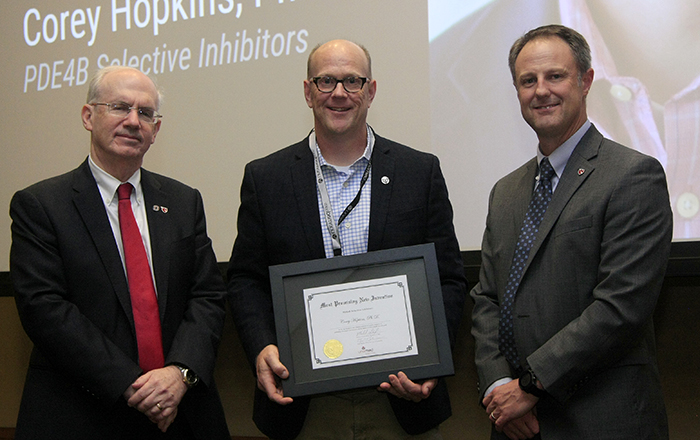
From left are University of Nebraska President Jeffrey Gold, MD, Corey Hopkins, PhD, and UNeMed President and CEO, Michael Dixon, PhD. Dr. Hopkins’ PDE4B Selective Inhibitors was named UNeMed’s Most Promising New Invention of the year during the 2019 Innovation Awards ceremony on Thursday, Oct. 17.
UNMC’s technology transfer and commercialization office, UNeMed, helped establish Goldenrod in 2023. UNeMed also created the licensing framework for the technology’s use and development.
“Drug discovery is some of the most important work we do at UNMC, and investors place real value on new molecules and discoveries,” UNeMed’s President and CEO, Michael Dixon, PhD, said. “A raise like this shows what our science is worth, and the Center for Drug Design and Innovation is at the heart of that effort. As our research enterprise grows, continued investment in drug discovery and development will be critical to our success creating and developing new therapeutics.”
PDE4 is involved in several inflammatory diseases such as chronic obstructive pulmonary disease, rheumatoid arthritis, inflammatory bowel disease, and central nervous system diseases that include drug addiction, schizophrenia and neurodegenerative diseases like Alzheimer’s, Multiple Sclerosis, ALS, and Batten Disease.
Goldenrod will initially focus on Friedreich’s Ataxia as the company moves toward regulatory approval. Friedreich’s Ataxia is a rare, progressive neurodegenerative genetic disorder that typically begins in childhood or adolescence. The disease causes progressive nerve damage, spinal deformities, impaired coordination and balance, and can lead to vision and hearing loss. Although treatment options remain limited, the condition is incurable, and many individuals require the use of a wheelchair within 10-20 years of symptom onset.
“One of the things I love most about drug discovery is that you never know where a promising molecule might end up helping the most,” Dr. Hopkins said. “This condition desperately needs new treatments, so it’s amazing to be closing that gap.”
Existing medications targeting PDE4 carry with them severe side-effects—like nausea and vomiting—and have poor uptake into the central nervous system.
Dr. Hopkins’ new compound reduced the potential for adverse side-effects while showing dramatic improvement in brain uptake.
“This is what world-class drug discovery looks like, and it is happening right here at UNMC,” Dr. Dixon said. “Dr. Hopkins and his team have designed a molecule that overcomes a problem the pharmaceutical industry wrestled with for decades, and now a company has the capital to carry it into the clinic.”
The successful round was led by Ataxia Ventures and an affiliate of Fannin Partners.
“The scientific foundation established at [UNMC] and Fannin has positioned 11h as a potentially important advancement in CNS-targeted PDE4 inhibition,” said Tom Hamilton of Ataxia Ventures, “…with potential relevance across a broader range of diseases.”