OMAHA, Nebraska (April 8, 2026) — A software platform that grades and monitors retinal diseases won the top prize of UNeMed’s 2026 Back-o-the-Napkin Contest, officials announced today.
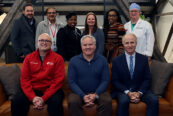
Selected from a total of 20 entries, the winning idea was a cross-campus collaboration between UNMC’s Ron Krueger, MD, and Ashok Puri, MBBS, and UNL’s team of Ashok Samal, PhD, and Sanyam Agarwal. Their inventive approach would optimize diagnosing and monitoring retinal diseases while offering optimal treatment strategies for improved patient outcomes. As the winning entry, the project will receive additional developmental support and guidance.
Contest entries were judged on the following criteria: patentability, feasibility and market size. Eligible inventions included artificial intelligence programs or systems, software tools and applications, medical devices and research tools. All entries for the contest were also evaluated for their novelty and commercial potential. Even though only one entry could be selected for the prize, several other submissions are expected to move forward with additional testing or research.
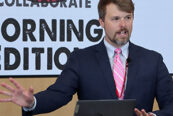
“Our gobs are smacked after receiving the highest number of contest entries to date,” UNeMed senior licensing specialist and contest director Amanda Hawley, PhD, said. “The submissions reflect the ingenuity and the innovative mindset of the University of Nebraska System at work.”
There were a record-high 20 entries, representing 18 departments and three campuses. UNMC fielded entries from the Colleges of Medicine, Allied Health, and Munroe Meyer. UNO was represented by the Colleges of Education, Information Systems and Quantitative Analysis and Information Science and Technology, and the National Counterterrorism Innovation, Technology, and Education Center. The invention from UNL was from the College of Engineering. Four of the total submissions were the result of inter-campus collaborations between UNMC, UNO and UNL.
“It is wonderful to witness fruitful collaborations amongst our University of Nebraska clinicians and researchers,” Dr. Hawley said. “It truly takes a village to move innovations forward. Expanding our inter-campus connections, expertise and resources can only bolster the commercial potential for university inventions.”
On average, UNeMed, the technology transfer and commercialization office for UNMC and UNO, will process about 100 new inventions every year from faculty, staff and students. The nature of inventions varies widely, ranging from software solutions and novel therapies to research tools and medical devices.
“The advancement of many inventions stall out simply from a lack of resources,” Dr. Hawley said. “The support from the contest can bring in experts and skilled developers to give a much-needed boost to help make these inventions a reality and move to the next phase of development. And without it, these impactful innovations would fade into obscurity, never knowing their true potential.”
The winning invention was titled, “A Retinal Disease Monitoring Platform and a Clinically Aligned Evaluation Metric for Retinal Lesion Segmentation.”
UNeMed and the UNMC Great Plains IDeA-CTR co-sponsored the contest.