UNeMed gains record licensing revenue with tenfold increase
From the December 10, 2010 issue of the Midlands Business Journal. Reprinted with permission.
UNeMed’s work to see ideas and research become products and solutions that may be sold and used to advance health care is shown with the likes of Vireo Systems or Virtual Incision.
Vireo is a manufacturer of nutritional supplements with a brick and mortar presence in Plattsmouth, Neb., which has been an economic engine generating jobs and even overseas business. Virtual Incision Corp. is set to make its remotely controlled surgical tools available to health care practitioners. These research initiatives-turned-viable businesses represent the seven of every 10 patents that go on to be licensed — and in turn available to industry — thanks to UNeMed’s support.
“One of the central criticisms of any technology transfer is to patent things that are not available to industry,” said CEO Dr. James Linder. But in this case, he said, 70 percent of all the ideas are later commercialized and “sent out the door” to be used by the greater society.
This is in contrast to the industry average for programs comparable to UNeMed, which focus on taking intellectual property out of the lab and bringing it to the marketplace.
“The national average is 50-50,” said President Michael Dixon, PhD As such, the idea has just as much of a chance of never being broadly used, as it does of being utilized by industry; however, the odds are in favor of success on this front, with regard to UNeMed.
Specifically, Dixon said, as of mid- November there were 543 patents and patent applications. Of those, 377 are licensed.
“That means a company is working to develop it into a product,” he said.
Dixon said the total number grows by some 15 to 25 patents each year. With regard to actual license agreements, UNeMed expects roughly 15 to 17 new ones every year. Last year, he said, it was on the higher end of the scale at 17. These new licensing agreements also represent a twofold increase over 2006 and 2007 figures, according to Dixon.
“Just looking at last year, our licensing revenue was $2.1 million, which was the most we’ve been able to generate with tech licensing ever,” he said, noting this represents a tenfold increase in the past four to five years.
Linder attributes such boosts directly to Dixon and his team’s interfacing with industry.
“We try to be an inventor-friendly office, as well as an industry-friendly office,” he said. “We want to see the technology put to use, and we’re not difficult to work with.”
For example, Linder noted that in addition to listening to one’s needs, technology may be utilized for some time before full terms kick in, which helps to develop a relationship with what he coins a “mutually beneficial arrangement.”
UNeMed has also got a little help from some external factors.
“The country’s been in an economic downturn for a couple of years now and that’s caused a lot of job loss, and companies are looking for ways to get back on track,” Linder said. “There is more of a national emphasis on looking into universities and trying to understand there is technology there to try to utilize.”
In fact, Dixon referred to the $130 million in research activity at the med center, which shoots up to more than $350 million when combined with other research institutions, like Creighton University.
In turn, Linder said the organization’s team has worked hard to develop relationships and collaborate with other entities, such as the Peter Kiewit Institute. Linder is also on the board of the Halo Institute; based out of Creighton, it seeks to transform ideas into viable business in part through the guidance of existing business professionals.
UNeMed is also focusing on fostering relationships that enable long-term research to be funded, in a way that flies in the face of traditional funding, through the likes of NIH grants.
The UNeMed team supports entrepreneurs in other ways as well, recently judging three business plan competitions in one week. It’s also working to solidify plans for a technology commercialization and economic development conference, with a focus on government-related tech transfer, in March.
It’s expected that more than 100 universities and 30 companies hailing from at least 17 states will be on hand.
UNeMed and Biomedical Research in Nebraska
The Reader interviews UNeMed President Dr. Michael Dixon who discusses the role that UNeMed plays in the transfer of Biomedical innovations and the research environment in Nebraska. (Link to full story in The Reader.)
Healthy Economy
by Steve Brewer
Billions of dollars go into medical research, and billions can eventually be made from the resulting products.
Unfortunately, there is often a large gap between an idea and its profits. This is called the “valley of death” in the health care field, and it’s UneMed’s job to bring local ideas through that valley to the other side.
UNeMed is a division of the University of Nebraska Medical Center, transferring intellectual property from the laboratory to the marketplace and helping to build a bioscience sector in Omaha and Lincoln. UNeMed is funded by UNMC, and from royalties generated from licenses. UNMC researchers brought in more than $115 million of funding during the 2009-10 fiscal year, from around 200 funded projects. According to UNeMed president Michael Dixon, all inventions stemming from that research are submitted to his division and evaluated for commercial potential.
“We look at two things,” Dixon says. “First, can we get intellectual property (IP) protection? We utilize sophisticated search techniques, and have a patent attorney in-house. If there is not IP available, we probably cannot invest in it.”
The second factor is the potential market for an invention, and that is more difficult to measure. UNeMed’s 12 full-time employees and six interns talk with contacts in the industry and investigate competitive products.
“Is this quicker, faster, better?” Dixon says. “Do we have an advantage? We try to assess the possible value.”
“We license the technology or start a company that licenses it,” Dixon says. “We have about 120 technologies available for licensing right now, and we do between 12 and 18 new licenses per year. Some of these are for new technology, and some for older technology.”UNMC researchers submit about 60 inventions to UNeMed annually, and Dixon’s staff applies for IP protection on about half of those. Dixon estimates that about five inventions per year eventually find a company interested in developing them.
Recent examples include PCR-related technology licensed by Streck, microbial isolates licensed by Sanofi Pasteur and airway management technology licensed by Truer Medical.
“Even if they (private companies) are not interested in an asset we have, perhaps there are some synergies and that allow productive research to go on. We want to bring in that corporate money to go along with government research money.”
Dixon says corporate sponsorships are typically in the range of $1 to $2 million, not including the sponsorship of clinical trials at UNMC.
UNeMed was founded in 1991, and Dixon says it was initially a struggle to persuade companies on the coasts that world-class research was being done in Omaha.
Dixon has a PhD in molecular biology from UNMC, and has worked for UNeMed since 2003. He was director of intellectual property and then chief operating officer before being named president last year.
As UNMC has become more prominent it has become easier to find potential business partners.
“UNMC is more on their radar now,” Dixon says. “We get into conversations quicker without having to describe where Omaha is. Now, we have companies coming to talk to us and they know about the work we are doing.”
Dixon says research by UNMC’s Center for Drug Delivery and Nanomedicine draws interest from many potential partner companies; so has work on Alzheimer’s and Parkinson’s diseases by Dr. Howard Gendelman.
There is a long timeline between a medical invention and the eventual financial payoff, and Dixon says one of UNeMed’s functions is to keep the momentum going through the slow times.
“Just to illustrate the timing involved, we are working with a start-up called Versalion right now on a delivery polymer for arthritis,” he says. “It shows more efficacy and fewer side effects, and has the ability to localize joints that are inflamed.”
This technology was presented to UNeMed three years ago by Dr. Dong Wang. Dixon says that makes it an “early stage” project.
“Assuming everything goes as well as possible, it could still be another seven to eight years before anything hits the market,” he says.
Versalion is talking to venture capitalists and hopes to close a Series A financing round soon.
UNeMed’s work is slow and can be costly, but Dixon believes it provides a big economic return for the area. He said 30 local jobs are created for every million dollars of research grants that UNMC brings in. The resulting technologies can create spin-off companies or persuade out-of-state companies to open offices here.
Dixon acknowledges bioscience is not yet one of the area’s premier economic sectors, but he believes that is changing. The nonprofit think tank Battelle recently assessed economic opportunities in Nebraska, and its report identified bioscience as one of the state’s strengths for the future.
“Between UNMC, Creighton Medical Center, Boys Town National Research Hospital, and people in Lincoln, you have a very strong corridor of bioscience,” Dixon says. “There are big research dollars, and very competitive grants being won. Omaha and Lincoln don’t really know about all of the biomedical research that’s going on.”
Virtual Incision completes $2 million Series A financing
The University of Nebraska technology based company Virtual Incision has completed their Series A financing round. (Link to full story at Marketwire.com)
Proceeds of Financing Will Be Used for Development of In Vivo Single Incision Laparoscopic Robotic Surgical Devices for Abdominal and Pelvic Procedures
LINCOLN, NE–(Marketwire – October 29, 2010) – Virtual Incision Corporation, a developer of in vivo robots for use in single incision laparoscopic surgery, today announced it has completed a $2 million Series A financing led by PrairieGold Venture Partners and Bluestem Capital. The Company also announced the establishment of its corporate headquarters in Lincoln, Nebraska, home to the University of Nebraska out of which the technology is exclusively licensed.
Proceeds from the financing will be used to develop advanced prototypes of the Company’s robotic surgical platform. The Company has engaged two experienced contract manufacturers — Honeybee Robotics and Devicix — to assist in the continued development of the robot and user interface, as well as Peter Hinchliffe, a medical device senior executive with over 17 years of experience managing multiple business areas at USSC (now Covidien) and Datascope (now MAQUET) who holds over 70 issued US patents.
The development of Virtual Incision’s technology is an important step in the evolution toward scarless surgical procedures performed on a robotic platform. Virtual Incision’s robots will offer a number of advantages. Insertion can be done through a single incision in the navel and requires just a few minutes. The platform will not require a dedicated operating room or other specialized infrastructure. Virtual Incision robots will be able to perform multi-quadrant surgery with quick, simple in vivo repositioning during a procedure while maintaining stable fixation. The technology utilizes existing tools and techniques surgeons are already familiar with, and the platform will be significantly less expensive than existing robotic alternatives.
The initial application of the Company’s technology will be for colon resection procedures. Currently, greater than eighty percent of these procedures are done “open,” that is, with a large incision down the center of the peritoneum. Open procedures have higher rates of morbidity, require longer hospital stays and leave larger scars than laparoscopic procedures. However, colon resection has not been widely adopted laparoscopically due to the complexity of the procedure. Because Virtual Incision’s robotic platform allows for multi-quadrant capability through a single port with stable fixation, the Company believes its technology will enable wider adoption of laparoscopic surgery for colon resection procedures, thus improving patient outcomes. Over time, the Company believes that its technology will have applicability across a number of surgical procedures.
The Company was founded by two University of Nebraska professors. Dr. Shane Farritor is a professor in the Department of Mechanical Engineering. Prior to coming to UNL he worked in the Field and Space Robotics Laboratory at the Massachusetts Institute of Technology and the Unmanned Vehicle Lab at the C.S. Draper Laboratories. He received his Ph.D and Masters in Mechanical Engineering from the Massachusetts Institute of Technology. Dr. Dmitry Oleynikov is an Associate Professor of Surgery, Joseph and Richard Still Faculty Fellow in Medicine, and Director of the Center for Advanced Surgical Technology at the University of Nebraska Medical Center. Dr. Oleynikov received his medical education at the Albert Einstein College of Medicine, Yeshiva University in 1994. He completed his residency at the University of Utah Medical Center and served as an instructor and senior fellow at the Center for Videoendoscopic Surgery at the University of Washington School of Medicine in Seattle. His current collaborative, multidisciplinary research interests include robotic surgical technology, educational simulation and clinical outcomes research.
“We are pleased to receive institutional funding at this critical time in the development of our robotic surgical platform,” said Dr. Farritor. “The University has been an excellent place to prototype and test multiple designs and concepts for our robotic technology, and we are excited to take this technology to the next level with our development partners and investors.”
“Virtual Incision is in a unique position to both change the way certain surgical procedures are performed through technological advances, as well as reduce healthcare costs by converting expensive open procedures to laparoscopic techniques,” said Mike Jerstad, partner of PrairieGold Venture Partners and Chairman of the Board of Virtual Incision. “Because the Company’s technology is simple to use and employs existing tools and techniques, we believe adoption of this innovative technology will be brisk.”
About Virtual Incision Corporation
Virtual Incision Corporation is a developer of in vivo robotic surgical devices that can be inserted through a single incision in the navel. Virtual Incision robots will be able to perform multi-quadrant surgery with quick, simple in vivo repositioning during a procedure while maintaining stable fixation. The technology utilizes existing tools and techniques surgeons are already familiar with, and the platform will be much less expensive than existing robotic alternatives. Headquartered in Lincoln, NE, Virtual Incision is backed by PrairieGold Venture Partners and Bluestem Capital. For more information, please visit www.virtualincision.com.
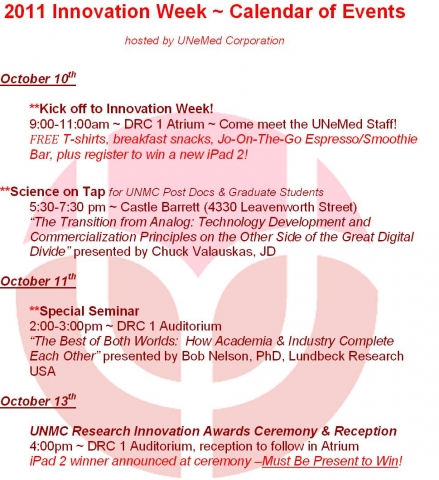
2010 Innovation Week
Calendar of Events
Monday – October 4th
** Kick off to Innovation Week
8am – 10am ~ DRC 1 Atrium ~ Meet the UNeMed Staff
FREE T-shirts, breakfast snacks & Jo-On-The-Go Espresso Bar
** Science on Tap ~ “Portraits of Care”
6:00pm – 7:30pm ~ Kaneko Center ~ 1111 Jones Street, Omaha
UNMC Clinical & Research Community
Refreshments & hors d’oeuvres will be sponsored by UNeMed
R.S.V.P. required to unemed@unmc.edu
Tuesday – October 5th
** Dr. David M. Brown of miRNA Therapeutics
Eppley Science Hall Amp ~ 1pm – 2pm
“Therapeutic Application of a Tumor Suppressor microRNA”
Thursday – October 7th
2010 Innovation Awards Ceremony & Reception
4pm ~ Awards Ceremony in the DRC Auditorium
5pm ~ Reception in the DRC 1 Atrium
Announce iPad drawing winner! (MUST BE PRESENT TO WIN)
Friday – October 8th
VA Presentation, “Technology Transfer at the VA”
Joe Runge, Business & Development Manager, UNeMed Corporation
9am – 10am – Education Conference Room
VA Nebraska-Western Iowa Health Care System, 4101 Woolworth, Omaha
**Register to win an iPad at the Oct. 4th & 5th events or at a UNeMed Office
location nearest you ~ DRC-1 Office Suite 1007 or ANX14 Office Suite 3000
UNeMed advances the ball on CEE enforcement front
OMAHA, Neb. (Aug. 6, 2010)—UNeMed Corporation has made progress in its efforts to enforce its intellectual property directed to creatine ethyl ester (CEE) used as a nutritional supplement. On April 1, 2010, the United States International Trade Commission issued exclusion and cease and desist orders against the four remaining respondents in Certain Products Advertised as Containing Creatine Ethyl Ester, 337-TA-679. The period of Presidential review of those orders expired on May 31, 2010 with no modifications being made to those orders. Thus, the respondents are no longer permitted either to import their products falsely advertised as containing creatine ethyl ester, or to sell any such products that have already been imported into the United States.
UNeMed has also concluded a license agreement with Bio-Engineered Supplements & Nutrition, Inc. (BSN) of Boca Raton, Florida for all of UNeMed’s worldwide issued patents directed to creatine ethyl ester. BSN is a major supplier of nutritional supplements in the United States and around the world.
Finally, UNeMed continues to pursue its remedies in New Zealand for patent infringement against Punch Supplements, an online seller of nutritional supplements in that country. UNeMed is evaluating its options to pursue similar remedies around the world against other, similar companies.
UNeMed Corporation is the technology transfer leader for the University of Nebraska Medical Center. UNeMed has a diverse technology portfolio that addresses significant medical and clinical needs in areas such as Therapeutics, Diagnostics, Medical Devices, Research Tools and Software. For further information regarding UNeMed and its patent portfolio, please contact Dr. Michael J. Dixon (mdixon@unmc.edu).
UNeMed deal with Eli Lilly puts UNMC in PD2 Program
OMAHA, Neb. (May 5, 2010)—UNMC is now a registered participant for a new Phenotypic Drug Discovery (PD2) program. Eli Lilly and Company, one of the world’s largest pharmaceutical companies, has launched the new drug discovery initiative created to identify new molecules that display activity in relevant disease models and that can serve as a foundation for the development of research collaborations between Eli Lilly and external researchers for the development of new therapeutic molecules.
The program allows UNMC researchers to submit potential therapeutic compounds for phenotypic drug screening. Researchers can submit compound structures by completing a New Invention Notification (NIN) through the UNeMed office. NIN forms are available on line at billowy-sleep.flywheelsites.com. The NIN will then be reviewed, by the UNeMed staff and if approved the researcher will receive an affiliation code to submit the compound(s) on line to Eli Lilly and Company.
If selected by Eli Lilly, the compounds will be screened for activity in five phenotypic assay modules: Alzheimer’s disease, Cancer (cell cycle arrest), Cancer (Anti-Angiogensis), Diabetes, and Bone Formation. Promising results may lead to a license agreement or collaboration between Eli Lilly and UNMC to further develop the drug molecules. Any UNMC researchers, who are interested in participating in this program, should contact Licensing Specialist Matt Boehm, PhD, mboehm@unmc.edu or 9-2166 in the UNeMed office for further details.
“The PD2 program provides a unique opportunity for UNMC researchers to gain valuable information about their compounds. This initiative also gives us a potential route to develop collaborations with a major pharmaceutical company,” said Dr. Boehm.
PD2 Website for more detailed information:
NU research translates into business opportunity
FROM THE OMAHA WORLD-HERALD
It’s all academic, but that doesn’t mean it can’t make good business sense.
When Omaha’s Streck Laboratories acquired the assets of Philisa Technology Corp., it was just the latest example of scientific research in the University of Nebraska system translating into real-world business opportunity.
Hendrik Viljoen, a professor in chemical biomolecular engineering with dual appointments at the University of Nebraska-Lincoln and the University of Nebraska Medical Center, was one of the owners of Philisa, along with Joel TerMaat, a doctoral candidate in chemical engineering at UNL, and Scott Whitney, a postdoctoral fellow in chemical engineering at UNL.
Viljoen called the work of UNeMed, the University of Nebraska Medical Center’s “technology commercialization office,” vital in helping his fledgling company succeed. He also credited NUtech Ventures. That organization is designed to raise money, write business plans and provide other help for startups built around NU research.
“When we started up, we basically just had ideas,” Viljoen said.
Michael Dixon, president of UNeMed, said UNMC has about $130 million in research currently being conducted, “and that generates a lot of new discoveries.”
“So … as we work with and develop the intellectual property associated with those discoveries, we try to find people who want to develop them commercially,” he said.
Dixon said UNeMed wants to see university research culminate in results that have real-world application and that produce revenue. “We’re a company trying to increase the economic value of the university.”
“This acquisition is important,” he said of the Streck-Philisa deal, “because we feel the technology will make it into the commercial marketplace and succeed.”
Viljoen said the product that attracted Streck’s attention is called a rapid PCR (polymerase chain reaction) thermocycler, “basically a device that enables you to make copies of certain specific regions of DNA.” It is useful for diagnosing diseases such as tuberculosis, among other applications.
Connie Ryan, president of Streck, said the rapid PCR thermocycler allows the company to continue to build presence in the molecular diagnostics market, which it recently entered with the creation of blood collection tubes for the preservation of cell-free DNA and RNA circulating in plasma.
“It’s new technology, and it gives us a new way to grow our business, and it’s clearly the future of clinical diagnostics,” she said.
Terms of the sale were not disclosed, but a portion of the proceeds went to UNeMed and NUtech Ventures, Viljoen said. That money is reinvested by the university into further research efforts.
“That’s our sole mission,” said David Conrad, executive director of NUtech Ventures.
Viljoen credited the business know-how of TerMaat, who now works at Streck as a project manager, as essential to Philisa’s success. He also said UNeMed and NUtech Ventures are doing a good job helping potential or new entrepreneurs.
Streck Laboratories became aware of Philisa after Ryan was approached by a friend who belonged to the Nebraska Angels, a group that explores early stage investment opportunities and start-up companies with ties to Nebraska.
“We thought it was such a great opportunity, not only because it was an innovative product and these are interesting, intelligent people to work with, but it’s Nebraska technology, developed at UNL and UNMC, and we were going to be able to keep it here,” Ryan said.
Conrad also was excited about keeping Philisa in the state. Viljoen and Whitney will serve as consultants to Streck.
“Not only was it a start-up that came out of the university and was operating in Lincoln but then the acquirer was also a Nebraska company,” Conrad said.
NUtech is emphasizing deals with Nebraska companies, in part so that more local jobs are created.
“There are several start-ups we’re working with in the pipeline that we hope go a similar path,” Conrad said.
Dixon estimated that UNeMed has developed seven to 12 products marketed commercially, with 35 to 40 more currently in development.
There are all sorts of upsides to the Streck acquisition, Dixon said, and not just for the principals and the university.
“It was a local company, and it was acquired by another local company, so it strengthened our local economy,” Dixon said. “We’re able to add jobs locally through the transfer of this technology into the commercial sector.”
He said the university-sponsored ventures need to be innovative and create business that will pull the state out of the economic slump.
That these companies have the potential to be bought and sold for millions of dollars means a lot to the local economy, Dixon said. “We’re very interested in helping to create as many high-growth companies as possible, based on technology.”
Ryan said it was exciting to see such great new technology coming out of UNL and UNMC.
“We’re hoping that it grows into a significant business,” she said.
$10,000 research award offered again in 2010
UNeMed once again will award $10,000 in unrestricted research funds to the inventor or group of inventors who submit the most promising invention.
|
All fully completed New Invention Notifications (NIN) submitted to UNeMed will be evaluated and considered for the grant.
NINs with potential benefits to the public good as well as the patent and market potentials will all be considered. All UNMC faculty, students and staff are eligible.
The award was introduced in 2008 to promote the disclosure of new inventions to UNeMed.
“There are many good ideas floating around campus and it’s our goal to help faculty, students and staff develop those ideas into products that reach the marketplace,” said Michael Dixon, PhD, president of UNemed.
The following researchers have received awards:
- Janina Baranowska-Kortylewicz, PhD, professor of radiation oncology (2008)
- Guangshun Wang, PhD, assistant professor in the Eppley Institute (2008)
- Paul Dunman, PhD, assistant professor in pathology and microbiology (2009)
Each received $10,000 in research funds.
INNOVATION WEEK 2009 ~ Photo Gallery
Innovation Week 2009
UNeMed would like to thank all who participated in Innovation Week 2009. Below is a look back at the week’s events.
Awards Ceremony Video Click Here
Honor Roll – Complete List of Innovation Awards Honorees
Inventors honored during Innovation Week awards ceremony
OMAHA, Neb. (Oct. 13, 2009)—Many UNMC researchers were honored for their innovations during UNeMed Corporation’s recent 2009 Innovation Awards ceremony in the Durham Research Center Auditorium.
UNeMed — UNMC’s marketing and licensing arm — honored 25 inventors of technology that resulted in 11 separate commercial licenses, and 14 inventors who have transformed eight different inventions into issued patents. This past year, UNeMed helped 112 inventors disclose 64 new invention notifications.
“UNeMed is linked to the research mission of UNMC,” said James Linder, M.D., chief executive officer of UNeMed. “Outstanding science creates the opportunity to improve health care, expand research and bring economic benefit to the inventors, UNMC and to Nebraska.”
Dr. Linder, Michael Dixon, PhD, president of UNeMed, and UNMC Chancellor Harold M. Maurer, M.D., presented awards.
Paul Dunman, PhD assistant professor in the department of pathology and microbiology, received the Most Promising New Invention award for novel antibiotic compounds he developed with UNL biology student Patrick Olson.
The award comes with a $10,000 unrestricted research grant from UNeMed.
Dr. Dunman’s work focuses on the identification and characterization of novel antimicrobial compounds.
The lifetime achievement award, presented every other year, went to Rodney Markin, M.D., PhD, professor of pathology and microbiology, the David T. Purtilo Distinguished professor of pathology and microbiology, senior associate dean for clinical affairs, College of Medicine, and chairman and president of UNMC Physicians.
“I am honored and flattered by this award,” said Dr. Markin, one of UNMC’s most prolific inventors. “It’s been a great experience and I’ve had wonderful support from UNMC all these years.”
Certificates of completion were presented to 22 people who participated in an 11-week Researcher Technology Commercialization webinar course earlier this year. The course, hosted by the National Council of Entrepreneurial Technology Transfer, focused on the successful commercialization of research and practical steps required to protect and market intellectual property.
Dr. Maurer congratulated awardees, talked about the growth of UNeMed and the impact of research inventions in building a world-class academic health science center.
“UNeMed is critical in helping innovators move intellectual property to a product that may have value for the community and for patients,” he said. “You are doing important work.”
Two receive iPods from UNeMed drawing
OMAHA, Neb. (Oct. 6, 2009)—During Innovation Week 2009, UNeMed Corporation once again awarded two event participants iPod Nanos.
The winners were:
Rajesh Wakaskar, graduate research assistant in the department of pharmacology and experimental neuroscience; and
Christelle Roux, PhD, a post doctoral research associate in pathology/microbiology.
As a thank you for participating in Innovation Week events, attendees were given opportunities to enter the contest. The more events attended the better the chances of winning.
“We were very pleased with the attendance at this year’s events,” said Michael Dixon, PhD, president of UNeMed. Innovation Week, which ran Sept. 28-Oct. 2, featured events such as:
A meet and greet with the UNeMed staff;
Christelle Roux, PhD, and Rajesh Wakashar with the iPod Nanos they won for participating in UNeMed’s Innovation Week activities.
A “Science on Tap” event at at the Crescent Moon with special guest Mellissa Helligso, medical technologist for The Nebraska Medical Center;
A panel discussion on lab funding with Paula Turpen, PhD, Mark Bowen and Mark Carlson, M.D.; and
A seminar by Paul Dunman, PhD, about the importance of accurate laboratory notebooks.
Dr. Markin honored for innovative solutions
OMAHA, Neb. (Oct. 2, 2009)—It fit perfectly with the family philosophy: We don’t buy it; we build it. Even as a child, Rod Markin, M.D., PhD, loved to problem-solve.
Together, he and his younger brother spent hours building walkie-talkies, oscilloscopes, furniture, car engines — even a garage.
Later, he took that innovative streak into the clinical laboratory, where he problem solved to automate processes to reduce turnaround time of medical testing and fill gaps created by workforce shortages.
Dr. Markin honored for innovative spirit
On Thursday, Dr. Markin — one of the most prolific inventors at UNMC — received the Lifetime Achievement Award from UNeMed Corporation for his innovations that have transformed the clinical laboratory.
“Dr. Markin adds a fourth leg to the proverbial triad of teaching, research and service,” said James Linder, M.D., chief executive officer of UNeMed Corporation. “He has shown tremendous leadership as an academic entrepreneur. This is an important role that our faculty can play in economic development for Nebraska.”
Major companies buy into Dr. Markin’s inventions
Dr. Markin’s patents are licensed to major corporations, including Abbott Laboratories, and they form the basis of modern clinical laboratory automation, Dr. Linder said.
As chairman and president of UNMC Physicians, Dr. Markin thrives on tackling difficult problems.
“If you can define the problem, there are 100 smart people who can find the solution,” he said. “Finding and framing the appropriate problem is often the hardest part.”
Dr. Markin’s professional and academic research interests have focused on solid organ transplantation, informatics and clinical laboratory automation, which includes:
- Robotics;
- Information systems;
- Medical utilization management; and
- Outcomes optimization.
During his career, Dr. Markin has:
- Secured 16 U.S. patents;
- Written more than 300 publications; and
- Published nearly 200 abstracts and chapters in books.
Solution for lab problems leads to business endeavor
In 1993, he founded LAB-InterLink, a spinoff of UNMC that provided products for hospital-based laboratory automation systems.
He also developed an automated microbiology platform for U.S. Army Medical Research and Materiel Command for use in the clinical laboratory.
“My goal was simply to solve problems for our clinical laboratory, not to build a product,” he said.
UNeMed assists with the patent process
But with the help of UNeMed officials, he learned how to protect and patent his ideas.
Obtaining a patent “means you’ve solved a problem no one else has solved,” Dr. Markin said. “The time and effort involved is similar to being published in a significant scientific journal.”
Spotlight on innovation – Meet Kathleen Healey, PhD
As part of Innovation Week (Sept. 28 – Oct. 2), UNeMed Corporation will spotlight the research of several UNMC inventors. Here, researchers discuss their passion for innovation and share their thoughts on the process.
OMAHA, Neb. (Sept. 17, 2009)—Obesity has been referred to as a national epidemic; nearly 55 percent of all Americans are either overweight or obese.
Obesity leads to several diseases and health issues including diabetes, heart disease and high blood pressure. Estimated costs attributed to obesity alone in the United States are approximately $99 billion annually.
Kathleen Healey, PhD, said the key to changing these statistics is education and behavioral modifications. Dr. Healey and her team, which includes a dietician, nurses and behavioral experts, developed the A-Wrist-A-Trac system.
The novel invention — a collection of color-coded bracelets — helps modify many types of behaviors, especially dietary intake. The bracelets track behavior and actions as they occur.
The method is simple. The bracelets are moved from one wrist to the other as an action is performed. Each bracelet color designates specific foods groups, as based on the USDA food pyramid.
“The idea of A-Wrist-A-Trac came to me as I reviewed the USDA Food Pyramid,” said Dr. Healey, who is an instructor in neurological sciences and a clinical associate with the College of Nursing.
Working in the field of multiple sclerosis, Dr. Healey sees patients on a daily basis. Prior to this, she worked with life style changes and risk factor modification in cardiovascular disease.
“Overall health influences disease state,” she said.
Dr. Healey’s team continues to study other uses for the A-Wrist-A-Trac system including medication guidance and monitoring of COPD, diabetes or other complex disease management regiments.
“It is important that future applications are scientifically-based,” she said. “There is value in all types of research especially behavioral studies in health care.”
Dr. Healey’s team has received national recognition for their innovation and have submitted their research results for publication.