OMAHA, Nebraska (February 1, 2021)—A startup company founded by UNMC College of Pharmacy scientist Dong Wang, PhD, landed a fast-track Small Business Innovation and Research grant of nearly $2 million for a potentially transformative new treatment for arthritis.
The initial Phase I National Institute on Drug Abuse award of $250,000 supported a successful proof of concept study. The Phase I grant was supported with an additional $100,000 in matching funds from the Nebraska Department of Economic Development. The $1.68 million Phase II funding was approved on Jan. 5, 2021. It will support a series of pre-clinical studies that are designed to open the door to filing an investigational new drug application with the FDA.
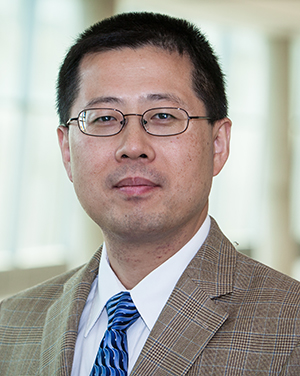
Dr. Wang
“This will prepare us for talking to the FDA about the design and implementation of a clinical trial to test the safety and effectiveness of the new drug,” Dr. Wang said, adding later: “We’re really lucky because the rheumatology and orthopedic programs at UNMC are world class, and have established the Nebraska Arthritis Outcomes Research Center, which has the personnel and expertise to conduct the clinical trials. The campus will be an ideal place to initiate the clinical studies.”
Dr. Wang founded Ensign Pharmaceutical on a novel formulation called ProGel, which is an injectable liquid. After ProGel is injected, it transforms into a gel-like substance as it reaches body temperature. The gel is then more likely to linger in the affected area, concentrating the pharmaceutical payload exactly where it needs to be.
Any number of pharmaceuticals can be combined with ProGel, making it a “platform technology.” Platform technologies like ProGel can be used for localized and sustained delivery of a variety of therapeutic agents to treat a broad spectrum of clinical conditions.
Ensign’s first product will incorporate a potent steroid, dexamethasone, into the ProGel formulation. The Phase II study will identify the optimal formulation, and evaluate its long-term efficacy in the treatment of arthritic joint pain.
Dexamethasone is a synthetic version of an anti-inflammatory steroid normally produced by the human adrenal gland. It is a common treatment for lupus, asthma and many other inflammatory diseases, and has gained recent notoriety for its potential in fighting the COVID-19 pandemic. When injected into a joint, dexamethasone provides temporary relief of debilitating pain and swelling caused by osteoarthritis, a chronic condition that slowly erodes the protective cartilage at the end of bones.
“It’s important to note that there is no known cure for osteoarthritis,” said Ensign’s Chief Medical Officer, Steven Goldring, MD, former Chief of Rheumatology at Beth Israel Deaconess Medical Center in Boston and Professor of Medicine at Harvard Medical School. “Unfortunately, the best we can do today is to manage the pain and inflammation.”
While effective for pain relief, the benefit of dexamethasone is unfortunately short-lived, usually lasting only a few days. However, when formulated with Dr. Wang’s ProGel, dexamethasone has the potential to remain active much longer, potentially providing relief for months.
“In mouse models of osteoarthritis, ProGel has shown effective pain relief for at least four months,” Dr. Wang said, “but a mouse is very, very different than a human being…These new experiments will help us to better predict how it may work in humans, and to optimize the drug design to provide similar sustained pain relief in humans.”
The hydrogel allows a slow release of the payload—dexamethasone, in this case—while being retained at the injection site. In addition to providing a more sustained and stable local release of medication, the hydrogel also has the benefit of limiting potential harmful side effects, including weight gain, increased blood sugar, insomnia and osteoporosis.
Ensign Pharmaceutical and ProGel also won the 2020 Business Innovation Live Pitch competition in Phoenix during the Orthopaedic Research Society’s annual meeting.
“Something like that is great because it shows us that we’re not the only ones who are excited about this technology and this company,” said Ensign’s CEO Brian Beck.

 Without question, the brightest highlight from the previous year was the
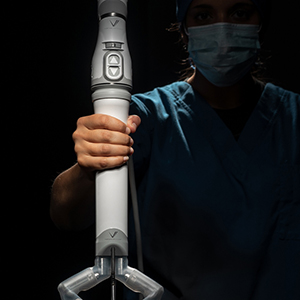 Any regular visitor to UNeMed.com is probably familiar with the continued success and growth of Virtual Incision Corporation. In January, the company announced the successful close of its Series B+ round of financing, to the tune of $20 million. The added capitol is expected to help the surgical robotics company clear regulatory hurdles and continue its intended transformation of laparoscopic surgery.
 Thanks to the pandemic and UNeMed’s resulting inability to host a live event, the Innovation Awards dropped a few spots after five straight years at the top of previous year-end lists. The virtual Awards ceremony named all 44 UNMC and UNO inventors of pandemic-related inventions as the 2020 Innovators of the Year. UNeMed also honored collaborators Joseph McMordie, MD, and Daniel Surdell, MD, for their device, “Anterior Cervical Space Spreader,” as the Most Promising New Invention of the year. UNeMed also recognized and celebrated the work of UNMC and UNO faculty, students and staff who contributed to a new invention disclosure, a licensed technology or received a United States patent during the previous fiscal year.
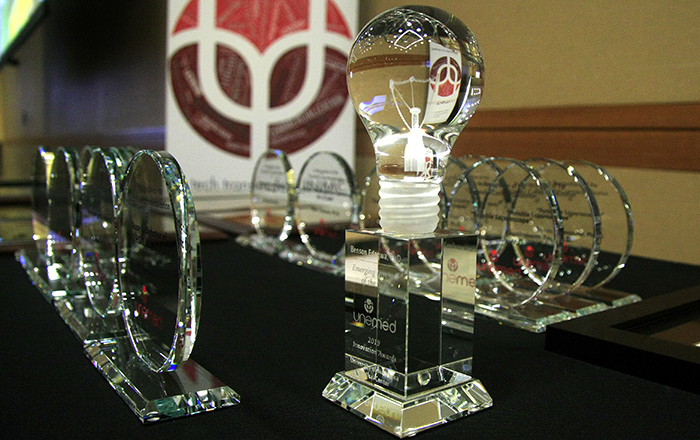
 The awards will be held via Zoom, and will honor all UNMC and UNO faculty, students and staff who submitted a new invention, were awarded a U.S. Patent or had a technology licensed during the 2020 fiscal year. UNeMed will also name the year’s Most Promising New Invention and will announce the “Innovator of the Year.”
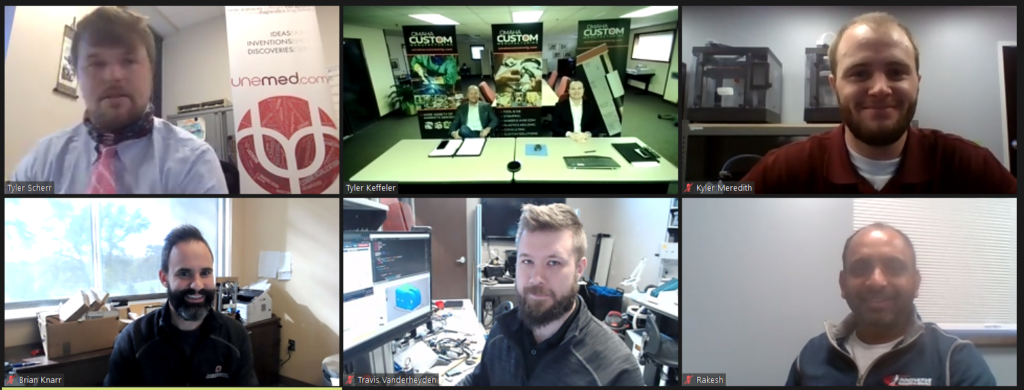 “When they come with a napkin, a lot more work has to be done before you get it pushed through, that’s for sure,” said panelist Mark Keffler, the CEO at Omaha Custom Manufacturing. “When we get a prototype in here, the first thing we have to do is dissect the prototype, figure out what makes it tick.”
 OMAHA, Nebraska (October 28, 2020)—Innovation Week continues today with an expert panel examining the local resources available to researchers, inventors and entrepreneurs interested in developing software and web applications.

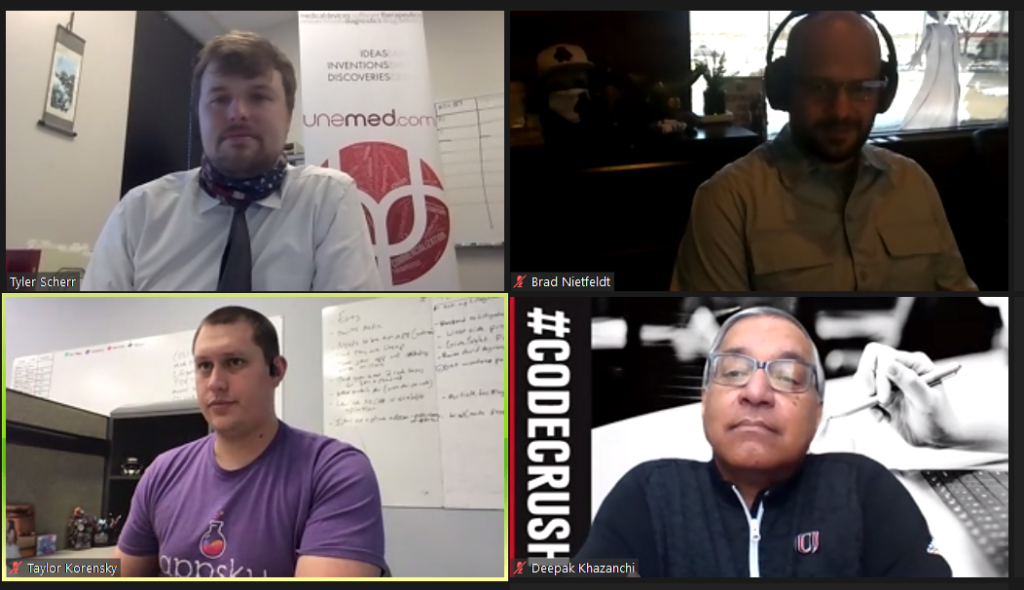 Among the panel’s recommendations included advice for academic researchers and innovators: Try not doing everything.